Battery First, Badges Later: A Used EV Buying Check That Cuts the Jargon
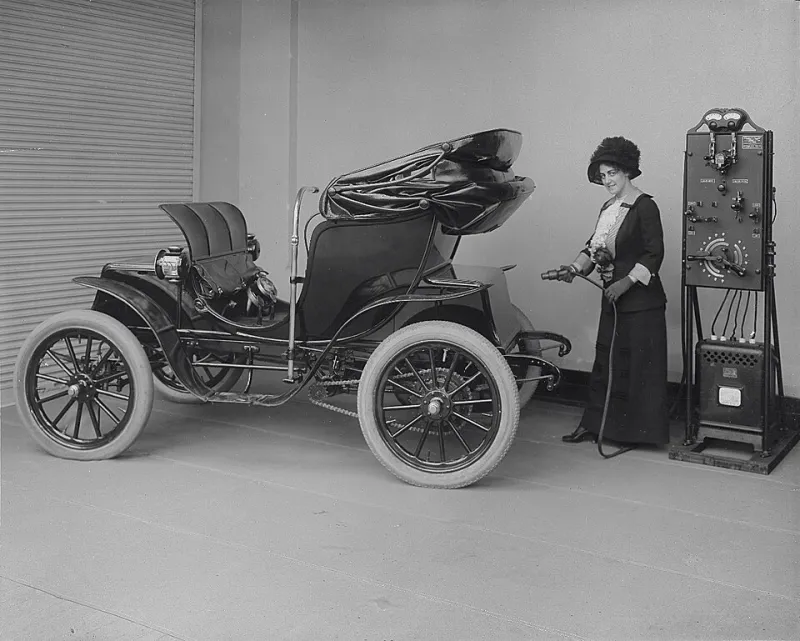
Photo: General Electric Company, Public domain, via Wikimedia Commons
Used electric cars are finally showing up in sensible numbers at sensible money. That is good news for buyers, but it also means more people are being asked to make a big decision about a technology they may not know much about. The good news is that you do not need to become an EV engineer. You just need a sequence.
The battery is the car. Everything else matters, but the battery is the difference between a useful runabout and a very large paperweight. So start there, then work outwards.
Step one: get a state-of-health number
State of health, usually shortened to SoH, is the headline figure for battery condition. It compares the battery's current usable capacity with what it had when new. A used EV with a healthy battery will still do a useful chunk of its original range. One with a tired battery will not, no matter how shiny the paint is.
Ask the seller for a recent battery health report or a state-of-health printout. If they are a dealer, they should be able to provide one or arrange one. If they are a private seller, they may not have one, which is not automatically a red flag, but it means you need to get one yourself. Independent EV specialists can carry out a battery health check, and some cars have well-known apps and diagnostic dongles that owners use to read battery data. Do not rely on the dashboard range guess alone. It is a useful clue, not a certificate.
Ask whether the car is on its original battery, whether it has had any battery repairs, and whether the battery warranty is still active. Most mainstream EV batteries have a long warranty, often around eight years or 100,000 miles, with a minimum health threshold. Check the exact terms for the car you are looking at. Some warranties transfer to a new owner, some have conditions about servicing, and some are void if the car has been damaged or repaired badly.
Step two: read the paperwork like you mean it
You want the V5C, service history, MOT history, recall paperwork and any battery or charging-related documents. Check that the car is not a write-off, has no outstanding finance and is not listed as stolen. A history check is cheap compared with the cost of a bad surprise.
Look for software updates and recalls. Early electric cars sometimes had battery management or charging software updates that matter. A dealer should be able to tell you whether outstanding recalls have been done. If they cannot, ask them to find out before you commit.
Also check the charging kit. A used EV should ideally come with the cables you need. That usually means a three-pin granny cable for occasional home charging and a Type 2 cable for public charge points. Some cars also support rapid charging via a CCS or CHAdeMO connector. Missing cables are not the end of the world, but they cost money to replace, so factor that into the price. Ask what charger, if any, is included at the seller's home. Usually the wallbox stays with the house, but it is worth clarifying so you are not disappointed.
Step three: test the range, not the badge
A test drive in an EV needs a plan. Ask the seller to charge the car to a known level before you arrive, ideally 80% or more. Note the indicated range, reset the trip computer, and then drive a route that includes town traffic, some faster roads and a stretch where you can safely keep up with motorway traffic. Use the heater or air conditioning as you would in normal life. Cold weather, hills and motorway speeds all affect range, so do not expect the dashboard number to be a promise.
Compare the miles you actually drive with the range the car says it has used. A big gap is not proof of a bad battery, but it is a reason to ask more questions. Check the charging screen and make sure the car recognises a charging cable. If there is a public charger nearby and the seller is willing, try a short rapid charge. You are not looking for a full charge; you are looking for a handshake, a sensible charging speed and no error messages.
While you drive, listen for unusual whines, clunks or vibration. Check that the heater, air conditioning, heated seats and infotainment all work. Look at the tyre tread and wear pattern. EVs tend to be heavy and can wear front tyres quickly, while brakes often last longer because of regenerative braking. That does not mean you should ignore brake condition; it means you should check it properly.
Questions to ask before you travel
- Can you send a recent battery state-of-health report?
- Is the battery warranty still active, and does it transfer to me?
- Has the car had any battery repairs or replacement?
- Are all charging cables included?
- Are there any outstanding recalls or software updates?
- What range do you realistically get in current weather?
- Has the car been involved in any accident or insurance write-off?
- Can I arrange an independent inspection?
If the seller dodges the basics, that tells you something. A good seller will not mind a sensible buyer asking sensible questions.
Red flags that justify walking away
Walk away if the seller will not share the registration or VIN before you travel. Walk away if there is no V5C or the name does not match the seller. Walk away if the car shows a battery warning light, a reduced power message or a charging fault you cannot explain. Be very cautious with cars that have been written off, repaired badly or have a battery warranty that has been voided.
Be wary of a car with no battery health information and no willingness to let you get an inspection. Be wary of a range estimate that sounds wildly optimistic for the age and mileage of the car. And be wary of a bargain that only works if you ignore the cost of replacement cables, a home charger or a battery that is clearly on its last legs.
The 2026 buying sequence
Check the advert and registration. Check the MOT and history. Ask for the battery health report. Get an insurance quote. View the car cold. Test the range on a mixed route. Try a charge if you can. Get an independent inspection if the numbers are close. Then negotiate with the cost of cables, tyres and any immediate work in mind.
A used EV can be a genuinely smart buy in 2026, especially for someone with off-street parking and a regular commute. But the battery comes first, the paperwork comes second, and the badge comes a distant third. That is the ALD Car Supermarket approach: checked and explained, so you know what you are actually buying.